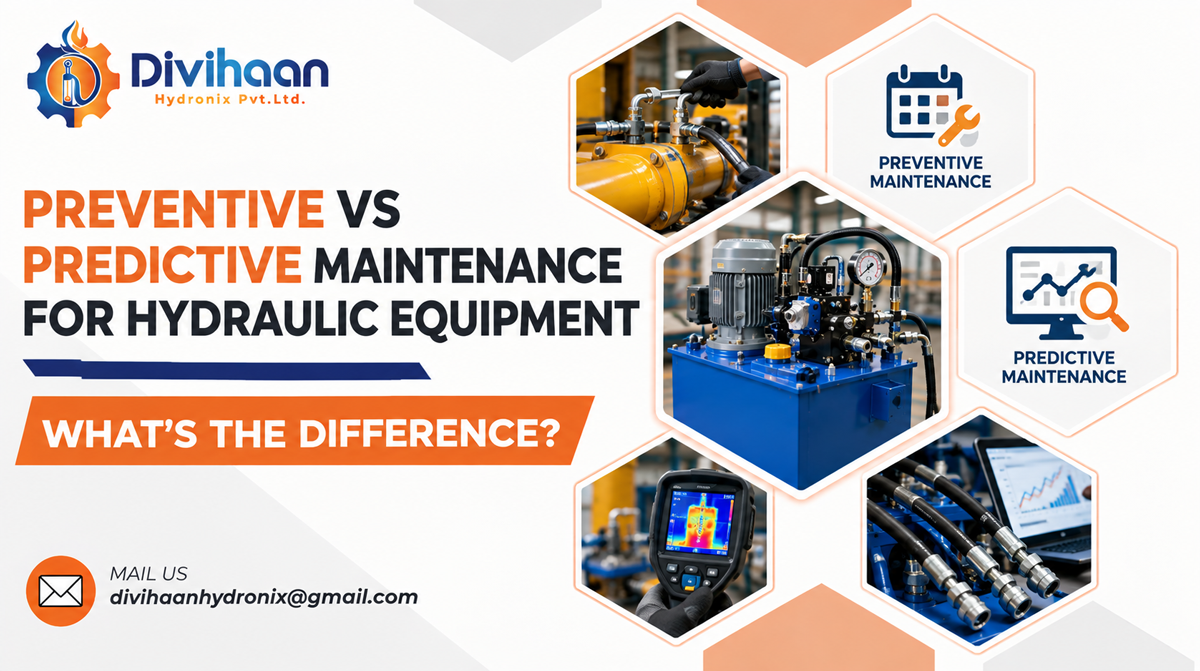
Preventive vs predictive maintenance for hydraulic equipment differs mainly in when maintenance is performed. Preventive maintenance follows a planned schedule based on time, operating hours, or manufacturer recommendations. Predictive maintenance uses actual equipment condition and performance data to identify when maintenance is likely to be required.
Both approaches can help reduce unexpected hydraulic failures, but they serve different purposes. For many industrial hydraulic systems, the most practical maintenance strategy combines scheduled hydraulic preventive maintenance with condition-based monitoring.
This guide explains the difference between preventive and predictive maintenance, their advantages and limitations, and how to determine the right approach for hydraulic equipment.
What Is Preventive Maintenance for Hydraulic Equipment?
Preventive maintenance for hydraulic equipment is planned maintenance carried out at predetermined intervals to reduce the likelihood of failure.
Instead of waiting for a hydraulic pump, cylinder, hose, filter, or valve to fail, technicians inspect and service components according to a defined hydraulic maintenance schedule.
Maintenance intervals may be based on:
- Operating hours
- Calendar periods
- Duty cycles
- Equipment manufacturer recommendations
- Previous maintenance experience
- Operating environment
What Does Hydraulic Preventive Maintenance Include?
A hydraulic preventive maintenance program may include:
- Checking hydraulic fluid levels
- Inspecting hoses and fittings
- Checking for external leaks
- Inspecting hydraulic cylinders
- Checking filters and filter indicators
- Monitoring operating temperature
- Inspecting seals and connections
- Checking pump operation
- Examining hydraulic oil condition
- Cleaning or replacing components as specified
- Verifying pressure and performance where required
The exact maintenance schedule should always reflect the equipment design, manufacturer recommendations, workload, environment, and safety requirements.
What Is Predictive Maintenance for Hydraulic Equipment?
Predictive maintenance for hydraulic equipment uses information about the actual condition of the machine to determine when maintenance may be necessary.
Instead of servicing a component simply because a fixed interval has arrived, technicians monitor indicators that can reveal deterioration or developing faults.
The goal is to identify abnormal conditions early enough to plan maintenance before they result in unexpected failure.
What Is Monitored During Predictive Hydraulic Maintenance?
Depending on the equipment, hydraulic condition monitoring can include:
- Hydraulic oil condition
- Particle contamination levels
- Oil temperature
- System pressure
- Pressure fluctuations
- Flow characteristics
- Pump noise or vibration
- Filter condition
- Leakage trends
- Cylinder performance
- Equipment operating data
Trend data can be particularly useful. A single measurement may not tell the full story, but changes in pressure, temperature, contamination, vibration, or performance over time can indicate developing problems.
Preventive vs Predictive Maintenance for Hydraulic Equipment: Key Differences
The simplest difference is:
Preventive maintenance asks: When is this equipment scheduled for maintenance?
Predictive maintenance asks: What does the equipment’s current condition tell us about when maintenance is needed?
| Factor | Preventive Maintenance | Predictive Maintenance |
| Basis | Time or operating schedule | Actual equipment condition |
| Maintenance timing | Predetermined | Condition-driven |
| Data requirement | Relatively low | Higher |
| Monitoring | Periodic inspection | Regular or continuous condition monitoring |
| Initial complexity | Lower | Generally higher |
| Main objective | Prevent failure through scheduled servicing | Detect deterioration before failure |
| Technology | Basic inspection and service tools | May use sensors, oil analysis and monitoring equipment |
| Best suited for | Routine hydraulic maintenance | Critical/high-value hydraulic equipment |
Neither method is automatically better. The appropriate strategy depends on the equipment and the consequences of failure.
Benefits of Preventive Maintenance for Hydraulic Systems
A structured hydraulic preventive maintenance program provides several advantages.
1. Simple to Plan
Maintenance teams can create schedules around operating hours, production cycles, shutdown periods, or manufacturer recommendations.
2. Helps Identify Visible Problems Early
Routine inspection can reveal leaking hoses, loose fittings, damaged seals, abnormal fluid levels, or other obvious problems before they worsen.
3. Supports Consistent Hydraulic System Maintenance
A documented schedule reduces dependence on maintenance being performed only after operators notice a problem.
4. Suitable for Many Types of Hydraulic Equipment
Preventive maintenance can be applied to hydraulic power packs, cylinders, presses, pumps, valves, hoses, industrial machinery, and mobile hydraulic equipment.
Limitations of Preventive Hydraulic Maintenance
Scheduled maintenance has limitations.
A component may be serviced even though it is still operating correctly. Conversely, a fault may develop between scheduled inspections.
Maintenance intervals that are too short can result in unnecessary servicing, while intervals that are too long may allow developing problems to go unnoticed.
For this reason, maintenance schedules should not be copied blindly from unrelated machines or applications.
Benefits of Predictive Maintenance for Hydraulic Equipment
Predictive hydraulic maintenance can provide additional insight into equipment health.
1. Detects Developing Hydraulic Problems
Condition monitoring can reveal trends that may not be obvious during a visual inspection.
For example, changes in contamination, operating temperature, vibration, pressure, or performance can indicate deterioration.
2. Helps Plan Maintenance Around Equipment Condition
Instead of relying only on fixed intervals, maintenance decisions can be supported by measured data.
3. Can Reduce Unexpected Downtime
Detecting deterioration before a critical component fails can provide more time to schedule inspection, repair, or replacement.
4. Supports Root-Cause Analysis
Historical condition data can help technicians understand whether recurring failures are associated with contamination, excessive temperature, pressure fluctuations, component wear, or operating conditions.
Limitations of Predictive Hydraulic Maintenance
Predictive maintenance is not simply a matter of installing sensors.
An effective program requires appropriate measurements, baseline data, consistent monitoring, trained personnel, and correct interpretation.
Depending on the hydraulic equipment, additional investment may also be required for sensors, oil analysis, monitoring devices, software, and specialist testing.
For small or non-critical equipment, extensive predictive monitoring may not always be economically justified.
Preventive vs Predictive Maintenance: Which Is Better for Hydraulic Equipment?
For many operations, the answer is both.
Preventive and predictive maintenance should not necessarily be treated as competing strategies.
Routine tasks such as inspections, housekeeping, checking fluid levels, and manufacturer-specified servicing can remain preventive. Condition monitoring can then be applied to critical equipment where unexpected failure could significantly affect production, safety, repair cost, or downtime.
When Should You Use Preventive Hydraulic Maintenance?
Preventive maintenance may be appropriate when:
- Equipment has predictable maintenance requirements.
- Manufacturer-defined service intervals are available.
- Components are relatively inexpensive to inspect or service.
- Condition-monitoring technology would add unnecessary complexity.
- Routine inspections can identify common failure modes.
When Should You Consider Predictive Hydraulic Maintenance?
Predictive maintenance may be valuable when:
- Hydraulic equipment is critical to production.
- Unplanned downtime is expensive.
- Components have high repair or replacement costs.
- Failure develops gradually and can be measured.
- Equipment operates continuously or under demanding conditions.
- Historical performance data can support maintenance decisions.
How to Build an Effective Hydraulic Equipment Maintenance Strategy
An effective hydraulic equipment maintenance program starts with understanding the machine rather than choosing a maintenance label.
Step 1: Identify Critical Hydraulic Equipment
Determine which pumps, cylinders, power packs, valves, presses, or other systems would cause significant operational impact if they failed.
Step 2: Follow Manufacturer Maintenance Requirements
Use the equipment manufacturer’s recommendations as an important baseline for service intervals, fluids, filters, inspections, and operating limits.
Step 3: Establish Baseline Operating Conditions
Record normal hydraulic pressure, temperature, oil condition, noise, vibration, cycle time, and other relevant parameters.
Without a baseline, it can be difficult to determine whether later measurements are actually abnormal.
Step 4: Control Hydraulic Fluid Contamination
Contamination can contribute to wear and reliability problems in pumps, valves, cylinders, and other precision components.
Proper filtration, clean maintenance practices, correct fluid handling, and periodic fluid-condition checks should form part of the maintenance program.
Step 5: Track Maintenance and Equipment Trends
Record inspections, leaks, repairs, component replacements, oil condition, temperature, pressure, and recurring problems.
Over time, this information can help maintenance teams identify patterns and make better decisions.
Can Predictive Maintenance Replace Preventive Maintenance?
Not completely.
Even a well-monitored hydraulic system still requires routine inspection and manufacturer-specified maintenance. Sensors and condition data cannot replace every physical inspection, fluid-level check, filter service, hose examination, or safety procedure.
A more effective approach is often to use preventive maintenance as the foundation and add predictive techniques where condition data can meaningfully improve reliability and maintenance decisions.
Why Hydraulic Equipment Maintenance Matters
Hydraulic equipment often operates under demanding pressure, temperature, load, and environmental conditions. Small issues such as contamination, leaks, deteriorating seals, abnormal temperature, or component wear can develop into larger failures if they are ignored.
A well-planned hydraulic system maintenance strategy can help improve equipment reliability, support safer operation, reduce unnecessary downtime, and make maintenance more predictable.
For businesses operating hydraulic machinery, Divihaan Hydronix provides hydraulic solutions and technical support for a wide range of industrial applications.
Frequently Asked Questions
What is the main difference between preventive and predictive maintenance?
Preventive maintenance is performed according to a planned time or usage schedule. Predictive maintenance uses actual equipment-condition data to help determine when maintenance is needed.
What is an example of preventive maintenance in a hydraulic system?
Examples include scheduled hose inspections, filter servicing, fluid-level checks, leak inspections, and other maintenance performed at defined intervals according to equipment requirements.
What is an example of predictive maintenance for hydraulic equipment?
Monitoring hydraulic oil contamination, temperature, pressure, vibration, or performance trends to identify developing deterioration is an example of predictive maintenance.
Is predictive maintenance more expensive than preventive maintenance?
Predictive maintenance can require higher initial investment because it may involve sensors, testing equipment, oil analysis, software, and specialist expertise. However, its value depends on equipment criticality and the cost of unexpected failure.
How often should hydraulic equipment receive preventive maintenance?
There is no universal interval for every hydraulic system. Maintenance frequency should be based on manufacturer recommendations, operating hours, workload, environmental conditions, system design, and maintenance history.
What hydraulic components should be monitored regularly?
Depending on the system, maintenance teams may monitor hydraulic fluid, filters, pumps, cylinders, hoses, fittings, valves, seals, operating pressure, temperature, and overall machine performance.
Can predictive maintenance prevent all hydraulic failures?
No. Predictive maintenance can help identify measurable deterioration, but sudden failures and faults without useful warning indicators can still occur. Routine inspection and preventive maintenance remain important.
Can preventive and predictive maintenance be used together?
Yes. A combined approach is often practical. Preventive maintenance handles routine scheduled requirements, while predictive monitoring helps identify developing problems in critical equipment.
Conclusion
The key difference in preventive vs predictive maintenance for hydraulic equipment is how maintenance timing is determined. Preventive maintenance follows predefined intervals, while predictive maintenance uses equipment-condition data to identify developing problems and support maintenance decisions. For many hydraulic operations, the strongest strategy is not choosing one over the other. Combining hydraulic preventive maintenance with appropriate predictive maintenance and condition monitoring can provide a more complete approach to equipment reliability.
Regular inspections, contamination control, proper fluid management, condition monitoring, maintenance records, and timely technical intervention can all contribute to longer-lasting and more reliable hydraulic equipment.
Looking to improve hydraulic equipment reliability or address recurring hydraulic system problems? Contact Divihaan Hydronix for hydraulic solutions, maintenance support, and technical assistance.