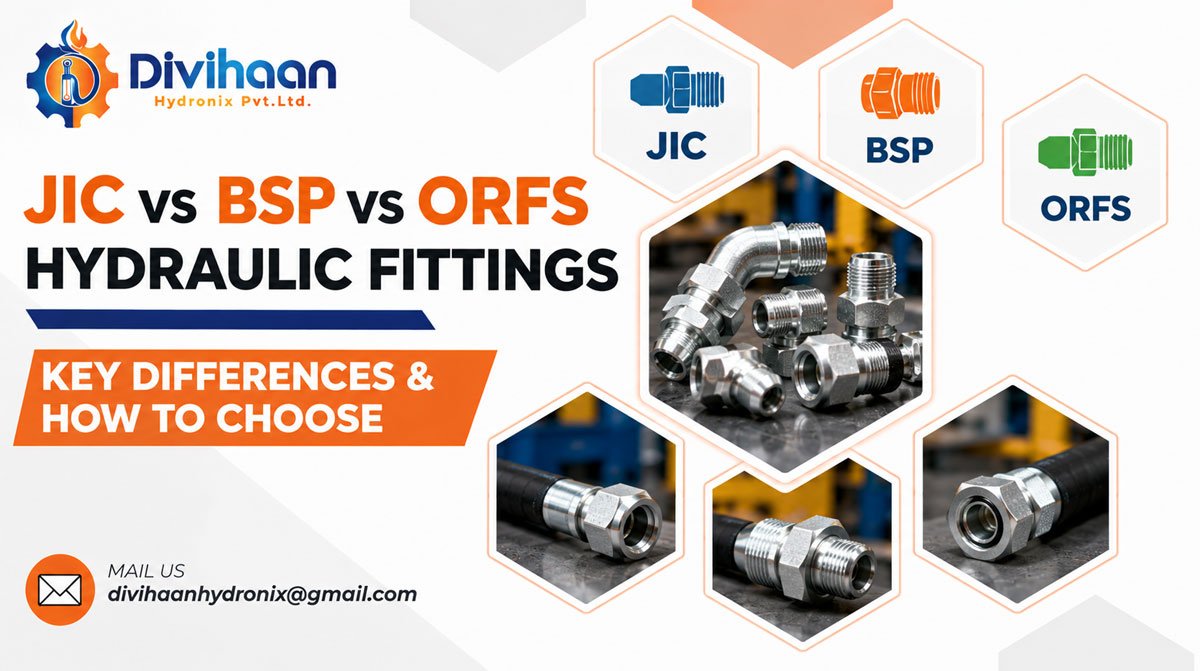
Understanding JIC vs BSP vs ORFS hydraulic fittings is essential when selecting reliable connections for industrial hydraulic systems. Although these hydraulic fitting types may look similar, they differ in thread design, sealing method, pressure capability, and application requirements. Choosing the wrong fitting can cause hydraulic oil leakage, damaged threads, connection failure, and unexpected equipment downtime.
JIC hydraulic fittings use a 37-degree metal flare seal, BSP fittings use British Standard Pipe threads with different sealing arrangements, and ORFS hydraulic fittings use an O-ring compressed between flat sealing faces.
Knowing these differences helps maintenance engineers, hydraulic technicians, and equipment manufacturers select compatible fittings for hydraulic hoses, pumps, cylinders, valves, and industrial machinery.
Quick Answer: What is the difference between JIC, BSP and ORFS hydraulic fittings?
The main difference between JIC, BSP, and ORFS hydraulic fittings is their thread geometry and sealing mechanism. JIC fittings seal through a 37° metal-to-metal flare. BSP fittings use 55° Whitworth threads and may seal through a washer, cone, O-ring, or tapered thread depending on the design. ORFS fittings use a flat-face O-ring seal. These connections are not directly interchangeable.
What Are Hydraulic Fittings and Why Are They Important?
Hydraulic fittings connect hoses, tubes, pipes, and components within a hydraulic system.
They help maintain secure fluid connections while accommodating the system’s operating pressure, temperature, and installation requirements.
Hydraulic fittings are commonly used in:
- Hydraulic presses and industrial machinery
- Construction and earthmoving equipment
- Agricultural machinery
- Hydraulic power packs
- Manufacturing and automation systems
- Material-handling equipment
The correct hydraulic fitting must match the connection thread, sealing design, pressure rating, fluid compatibility, and operating environment.
A fitting with a matching thread diameter is not necessarily compatible with another fitting because its sealing surface may be different.
JIC vs BSP vs ORFS Hydraulic Fittings: Quick Comparison
The following comparison highlights the main technical differences.
| Feature | JIC | BSP | ORFS |
| Full form | Joint Industry Council | British Standard Pipe | O-Ring Face Seal |
| Thread form | Unified, 60° | Whitworth, 55° | Unified, 60° |
| Thread design | Parallel | Parallel or tapered | Parallel |
| Sealing method | 37° metal flare | Depends on BSP connection type | Flat-face O-ring |
| Primary sealing material | Metal-to-metal | Metal, washer, or elastomer depending on design | Elastomeric O-ring |
| Common standards | SAE J514, ISO 8434-2 | ISO 228-1, ISO 7-1; connection-specific standards | SAE J1453, ISO 8434-3 |
| Typical applications | Mobile and industrial hydraulics | Industrial machinery and hydraulic ports | High-pressure, leak-sensitive hydraulic connections |
| Main consideration | Condition of flare surfaces | Correct BSP variant and sealing design | O-ring condition and compatibility |
These differences are consistent with published hydraulic connection identification guidance.
What Are JIC Hydraulic Fittings?
JIC hydraulic fittings are commonly used in industrial and mobile hydraulic systems.
They use a 37-degree flare connection to create a metal-to-metal seal between matching surfaces.
JIC fittings are associated with SAE J514 and ISO 8434-2 specifications.
How Do JIC Hydraulic Fittings Work?
A JIC fitting uses a male 37-degree cone and a corresponding female flare seat.
When correctly assembled, the threaded connection draws the mating sealing surfaces together.
The seal forms at the metal contact surfaces rather than along the threads.
Advantages of JIC Hydraulic Fittings
- Widely used in hydraulic equipment
- Suitable for many high-pressure applications when correctly rated
- No separate face O-ring required for the flare seal
- Serviceable connection design
- Available in different sizes and configurations
Limitations of JIC Hydraulic Fittings
JIC fittings require clean, undamaged sealing surfaces.
Scratches, deformation, misalignment, or excessive tightening can interfere with proper sealing.
Repeated assembly and disassembly may also damage the flare surfaces if handled incorrectly.
Where Are JIC Hydraulic Fittings Used?
Common applications include construction machinery, hydraulic power units, agricultural equipment, and industrial hydraulic hose assemblies.
JIC fittings are useful where the equipment already uses a compatible 37-degree flare connection.
What Are BSP Hydraulic Fittings?
BSP stands for British Standard Pipe.
BSP hydraulic fittings use a Whitworth thread form with a 55-degree thread angle.
Unlike JIC and ORFS, BSP refers to a thread family rather than one specific sealing method.
Two important BSP thread types are BSPP and BSPT.
BSPP vs BSPT Hydraulic Fittings: What Is the Difference?
BSPP – British Standard Pipe Parallel
BSPP fittings have parallel threads, commonly designated with the letter G.
These threads generally provide mechanical engagement, while the seal is formed through a separate sealing arrangement.
Depending on the connection design, BSPP fittings may use a bonded sealing washer, O-ring, or compatible cone seat.
BSPT – British Standard Pipe Tapered
BSPT fittings use tapered threads, commonly associated with R-series designations.
The connection relies on tapered thread engagement and the specified sealing method.
Suitable thread sealant may be required depending on the fitting design and manufacturer’s instructions.
BSPP and BSPT are not automatically interchangeable.
Advantages of BSP Hydraulic Fittings
- Commonly found in industrial machinery
- Available in parallel and tapered thread configurations
- Used across many hydraulic ports and components
- Multiple connection and sealing options
Limitations of BSP Hydraulic Fittings
Different BSP designs require different sealing arrangements.
Incorrectly identifying BSPP or BSPT can lead to damaged connections or leakage.
BSP fittings must also not be confused with similar-looking NPT threads.
Where Are BSP Hydraulic Fittings Used?
BSP connections are commonly found in hydraulic power packs, industrial equipment, valves, cylinders, and machinery manufactured for markets using British or international pipe thread conventions.
What Are ORFS Hydraulic Fittings?
ORFS stands for O-Ring Face Seal.
ORFS hydraulic fittings use an elastomeric O-ring positioned in a groove on a flat sealing face.
When correctly assembled, the O-ring is compressed against the mating surface to create a fluid-tight seal.
ORFS fittings are associated with SAE J1453 and ISO 8434-3.
How Do ORFS Hydraulic Fittings Work?
The male fitting typically has a flat face containing an O-ring groove.
The mating connection provides a corresponding flat sealing surface.
During assembly, the O-ring is compressed between these surfaces.
The threads provide the mechanical clamping force rather than acting as the primary seal.
Advantages of ORFS Hydraulic Fittings
- Strong sealing performance when correctly assembled
- Often selected for high-pressure applications
- Suitable for many vibration-sensitive installations
- Useful where hydraulic oil leakage must be minimized
- Serviceable with appropriate seal inspection and replacement
Limitations of ORFS Hydraulic Fittings
ORFS connections depend on the correct O-ring material, dimensions, and condition.
Damaged or contaminated sealing faces can cause leakage.
O-rings must also be compatible with the hydraulic fluid and operating temperature.
Where Are ORFS Hydraulic Fittings Used?
ORFS fittings are commonly used in mobile hydraulic machinery, industrial hydraulic equipment, high-pressure hose assemblies, and applications where leakage control is particularly important.
JIC vs ORFS Hydraulic Fittings: Which Is Better?
JIC and ORFS hydraulic fittings are both used in high-pressure hydraulic systems, but they have different sealing mechanisms.
JIC uses a metal-to-metal flare, while ORFS uses an elastomeric face seal.
JIC vs ORFS for High-Pressure Applications
Both fitting types can be suitable for high-pressure service when correctly specified.
ORFS is often preferred in applications where leakage control and vibration resistance are important.
JIC remains widely used for serviceable hydraulic connections.
However, neither type has one universal pressure rating. Pressure capability depends on fitting size, material, construction, and manufacturer specifications.
JIC vs ORFS for Hydraulic Oil Leakage Prevention
ORFS fittings provide a defined elastomeric sealing interface.
JIC fittings rely on correctly matched and undamaged metal flare surfaces.
Either design can leak if incorrectly assembled or used outside its rated conditions.
The correct choice depends on the existing equipment connection and application requirements.
BSP vs JIC Hydraulic Fittings: What Is the Difference?
The primary differences between BSP and JIC hydraulic fittings involve thread geometry and sealing design.
JIC uses a 60-degree Unified thread form and a 37-degree flare seal.
BSP uses a 55-degree Whitworth thread form and can incorporate different sealing arrangements.
Even when thread sizes appear similar, BSP and JIC fittings should not be connected directly unless an approved adapter is used.
Can BSP and JIC Hydraulic Fittings Be Interchanged?
No. They are different connection systems.
A suitable adapter may connect BSP and JIC interfaces, provided its specifications match both connections and the hydraulic system.
Never force incompatible threads together.
How to Identify JIC, BSP and ORFS Hydraulic Fittings
Correct fitting identification is essential when replacing hydraulic hoses or maintaining equipment.
Step 1: Inspect the Hydraulic Fitting Sealing Surface
After safely isolating and depressurizing the system, examine the fitting.
A JIC connection has a 37-degree flare sealing surface.
An ORFS connection has a flat sealing face with an O-ring groove.
A BSP connection requires further identification because it may use a cone, washer, O-ring, or tapered thread sealing arrangement.
Step 2: Check Whether the Threads Are Parallel or Tapered
JIC and ORFS connections use parallel threads.
BSP fittings may use parallel BSPP or tapered BSPT threads.
This helps narrow the identification.
Step 3: Measure the Hydraulic Fitting Thread
Use suitable tools, including:
- Vernier caliper
- Thread pitch gauge
- Thread identification chart
- Seat-angle gauge where required
Measure the thread diameter and pitch, then compare the results with verified fitting specifications.
Step 4: Confirm the Fitting Standard
Compare the measured dimensions and sealing design against the manufacturer’s technical documentation.
Do not identify fittings using thread diameter alone.
For example, some JIC and ORFS sizes can share the same thread dimensions despite using incompatible sealing surfaces.
How to Choose the Right Hydraulic Fitting for Your Application
Selecting the correct fitting requires more than choosing between JIC, BSP, and ORFS.
1. Verify the Existing Hydraulic Connection
Identify the equipment port, hose-end fitting, and required mating interface.
Match the actual connection specification rather than choosing a fitting based on appearance.
2. Check the Hydraulic System Pressure
Select a fitting with an adequate working pressure rating for the application.
Consider pressure surges and the ratings of the complete hose assembly.
3. Evaluate Hydraulic Fluid Compatibility
Verify that the fitting material and sealing components are compatible with the hydraulic oil.
This is particularly important for ORFS and other connections using elastomeric seals.
4. Consider Equipment Vibration
Evaluate whether the connection will experience frequent vibration, movement, or mechanical loading.
Choose a fitting and hose routing arrangement suitable for these conditions.
5. Follow Manufacturer Installation Instructions
Use the specified assembly procedure, tightening method, and inspection requirements.
Incorrect installation can damage threads and sealing surfaces.
Common Mistakes When Selecting Hydraulic Fittings
Confusing JIC and ORFS Connections
Both use Unified parallel threads, but their sealing surfaces differ.
A matching thread does not mean the fittings are compatible.
Mixing BSPP and BSPT Threads
Parallel and tapered BSP connections have different assembly and sealing requirements.
Using Incorrect Sealing Materials
Applying thread tape or sealant to connections designed to seal through a flare or O-ring can create contamination and assembly problems.
Use sealing products only where the manufacturer specifies them.
Overtightening Hydraulic Fittings
Excessive tightening can damage sealing surfaces, threads, or O-rings.
Ignoring Hydraulic Pressure Ratings
Fittings must be rated for the actual hydraulic application.
Reusing Damaged Seals
Damaged or unsuitable O-rings can lead to recurring hydraulic oil leakage.
Which Hydraulic Fitting Is Best for Industrial Machinery?
There is no single fitting type that is best for every hydraulic application.
| Application requirement | Selection consideration |
| Existing 37° flare connection | Compatible JIC fitting |
| Existing BSP hydraulic port | Correct BSPP or BSPT connection |
| Leak-sensitive hydraulic circuit | Consider appropriately rated ORFS |
| Frequent equipment vibration | Evaluate ORFS or other manufacturer-approved connections |
| Maintenance and replacement | Match original connection specifications |
| Mixed fitting standards | Use correctly rated, approved adapters |
For new equipment designs, the selection should consider pressure, fluid type, serviceability, vibration, component availability, and manufacturer recommendations.
For existing equipment, matching the original connection standard is generally the starting point.
Frequently Asked Questions About JIC, BSP and ORFS Hydraulic Fittings
1. What is the main difference between JIC, BSP and ORFS hydraulic fittings?
JIC fittings use a 37-degree metal flare seal, BSP fittings use British Standard Pipe threads with connection-specific sealing methods, and ORFS fittings use a flat-face O-ring seal.
2. Are JIC and BSP hydraulic fittings interchangeable?
No. JIC and BSP fittings use different thread geometries and sealing arrangements. A correctly specified adapter is required when connecting these interfaces.
3. Which is better for high pressure, JIC or ORFS?
Both can be suitable for high-pressure hydraulic applications. ORFS is often selected where leakage resistance is especially important, but actual pressure capability depends on the fitting’s published specifications.
4. What is the difference between BSPP and BSPT hydraulic fittings?
BSPP uses parallel threads and a separate sealing interface. BSPT uses tapered threads and an approved thread-sealing arrangement.
5. How can I identify a JIC hydraulic fitting?
A JIC fitting uses a 37-degree flare sealing surface and Unified parallel threads. Confirm the thread diameter, pitch, and sealing geometry against the manufacturer’s specifications.
6. Do ORFS hydraulic fittings require O-rings?
Yes. ORFS fittings use an O-ring at the flat sealing face. The O-ring must be the correct size and material for the application.
7. Can JIC and ORFS hydraulic fittings be connected together?
They should not be mated directly. Their sealing designs are incompatible. Use an appropriately rated adapter designed specifically for both connection types.
8. Which hydraulic fitting is best for vibration?
ORFS fittings are frequently selected for demanding hydraulic systems involving vibration and leakage-sensitive connections. However, suitability depends on correct assembly, pressure rating, and hose routing.
9. Can incorrect hydraulic fittings cause oil leakage?
Yes. Mismatched threads, damaged sealing surfaces, incorrect O-rings, and improper installation can cause hydraulic oil leakage or connection failure.
10. Are BSP and NPT hydraulic fittings the same?
No. BSP uses a 55-degree Whitworth thread form, while NPT uses a 60-degree thread form. Their dimensions and sealing requirements differ, so they should not be treated as interchangeable.
Conclusion: Choose the Correct Hydraulic Fitting for Reliable Connections
Understanding the differences between JIC, BSP, and ORFS hydraulic fittings helps maintenance teams select compatible hydraulic connections and avoid unnecessary equipment failures.
JIC fittings use a 37-degree metal flare seal, BSP fittings include parallel and tapered thread designs, and ORFS fittings use an elastomeric flat-face seal.
Each connection type has specific advantages and application requirements.
Correct identification, suitable pressure ratings, compatible sealing materials, and proper installation are essential for reliable hydraulic operation.
Need Guidance on Hydraulic Fittings and Hose Connections?
Selecting the right hydraulic fittings is important for maintaining safe and efficient industrial hydraulic systems.
For information about hydraulic components, fitting compatibility, and industrial hydraulic applications, connect with Divihaan Hydronix.
Visit www.divihaan.com to learn more and discuss your hydraulic requirements.