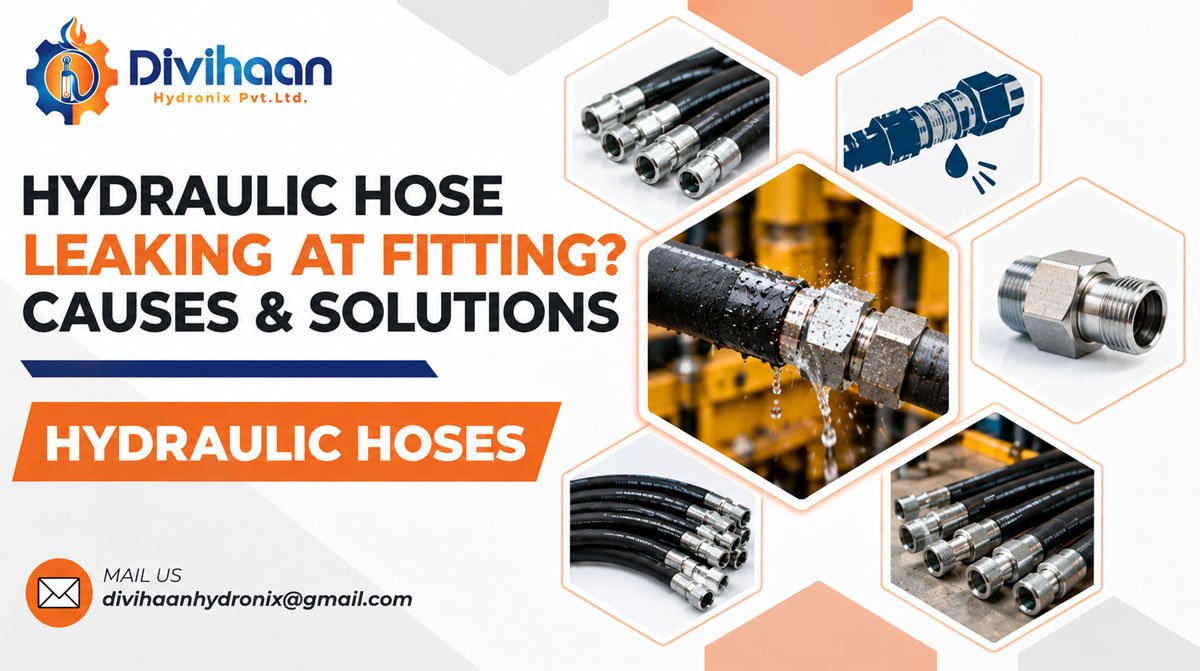
A hydraulic hose leaking at fitting connections is a common problem in industrial hydraulic systems. These leaks may result from loose connections, damaged seals, incorrect hose assembly, incompatible fittings, excessive pressure, or improper installation. Even a small hydraulic oil leak can lead to fluid loss, reduced equipment efficiency, contamination, unplanned downtime, and serious safety risks.
Understanding why hydraulic hoses leak at fittings helps maintenance teams identify the actual cause and select the appropriate corrective action.
Quick Answer: Why do hydraulic hoses leak at fittings?
Hydraulic hoses usually leak at fittings because of damaged seals, incorrect tightening, incompatible connectors, poor crimping, hose misalignment, vibration, or pressure-related damage. The correct fix depends on where the fluid escapes. Some connections require proper reassembly, while damaged fittings, seals, or hose assemblies may need replacement.
Importantly, never attempt to tighten, touch, or repair a hydraulic fitting while the system is pressurized. High-pressure hydraulic fluid can penetrate the skin and cause a medical emergency.
What Is a Hydraulic Hose Fitting Leak?
A hydraulic hose fitting leak occurs when hydraulic fluid escapes from the connection between a flexible hydraulic hose and its fitting, adapter, valve, cylinder, pump, or other hydraulic component.
Hydraulic hose fittings are designed to maintain a secure, leak-resistant connection under specified operating pressures and temperatures.
However, these connections depend on correct component selection, proper installation, suitable sealing surfaces, and appropriate operating conditions.
Where Do Hydraulic Hose Leaks Commonly Occur?
Hydraulic oil leakage may develop at several locations:
- Hose-to-fitting crimp: Where the fitting is permanently attached to the hose.
- Threaded connection: Where a fitting connects to a hydraulic port or adapter.
- O-ring sealing area: Where an elastomeric seal prevents fluid escape.
- Flare or cone sealing surface: Where metal surfaces form a seal.
- Hose near the fitting: Where excessive bending, vibration, or mechanical stress damages the hose.
Identifying the exact leak location is essential because different failure points require different repairs.
What Are the Main Causes of Hydraulic Hose Leaking at Fittings?
Hydraulic hose fitting leaks can develop due to installation errors, mechanical wear, unsuitable components, or operating conditions.
1. Loose or Incorrectly Tightened Hydraulic Fittings
Incorrect tightening is one possible cause of hydraulic oil leakage.
If a fitting is not assembled according to its manufacturer’s specifications, the sealing surfaces may not establish a reliable connection.
However, excessive tightening can also cause problems.
Overtightening may damage threads, deform sealing surfaces, or compress certain seals beyond their intended limits.
Common warning signs:
- Oil accumulation around the connection
- Repeated leakage after maintenance
- Visible damage to fitting threads
- Leakage after a fitting has been disconnected and reinstalled
Recommended fix:
After safely isolating and depressurizing the equipment, inspect the connection and follow the fitting manufacturer’s specified assembly procedure.
Use the appropriate tightening method for the fitting design. Torque requirements and assembly methods differ between O-ring face seal, flare, tapered-thread, and other connections.
Do not assume that additional tightening will stop every leak.
2. Damaged or Worn Hydraulic Fitting Seals
Many hydraulic fittings use O-rings or other sealing elements to prevent fluid leakage.
These seals can deteriorate because of:
- High operating temperatures
- Chemical incompatibility with hydraulic fluid
- Incorrect installation
- Excessive compression
- Aging and repeated thermal cycling
- Contamination or mechanical damage
A damaged O-ring may allow hydraulic fluid to escape even when the fitting appears securely connected.
Recommended fix:
Inspect the seal after the system has been safely depressurized and the connection disassembled.
Replace damaged seals with the correct material, size, and specification recommended for the connection.
Never substitute an O-ring based only on its approximate appearance or dimensions.
3. Incorrect Hydraulic Hose Crimping
Crimping is the process of permanently attaching a fitting to a hydraulic hose using specialized equipment.
A properly manufactured hose assembly requires compatible hose and fitting components, an approved crimping procedure, and correct dimensional verification.
Incorrect crimping can result in an unreliable connection.
Possible causes include:
- Incorrect crimp diameter
- Wrong crimping die
- Incompatible hose and fitting combinations
- Incorrect hose insertion depth
- Damaged fitting components
- Failure to follow the approved assembly specification
Recommended fix:
If hydraulic oil leaks from the crimped connection, remove the affected hose assembly from service.
Have a qualified hose assembly specialist inspect and replace it as necessary.
A leaking permanent crimp should not be treated as a normal threaded connection that can simply be tightened.
4. Incompatible Hydraulic Hose Fittings
Hydraulic fittings are available in different thread forms, sealing configurations, sizes, and pressure ratings.
Two fittings may appear similar but use different sealing designs.
For example, hydraulic systems may use:
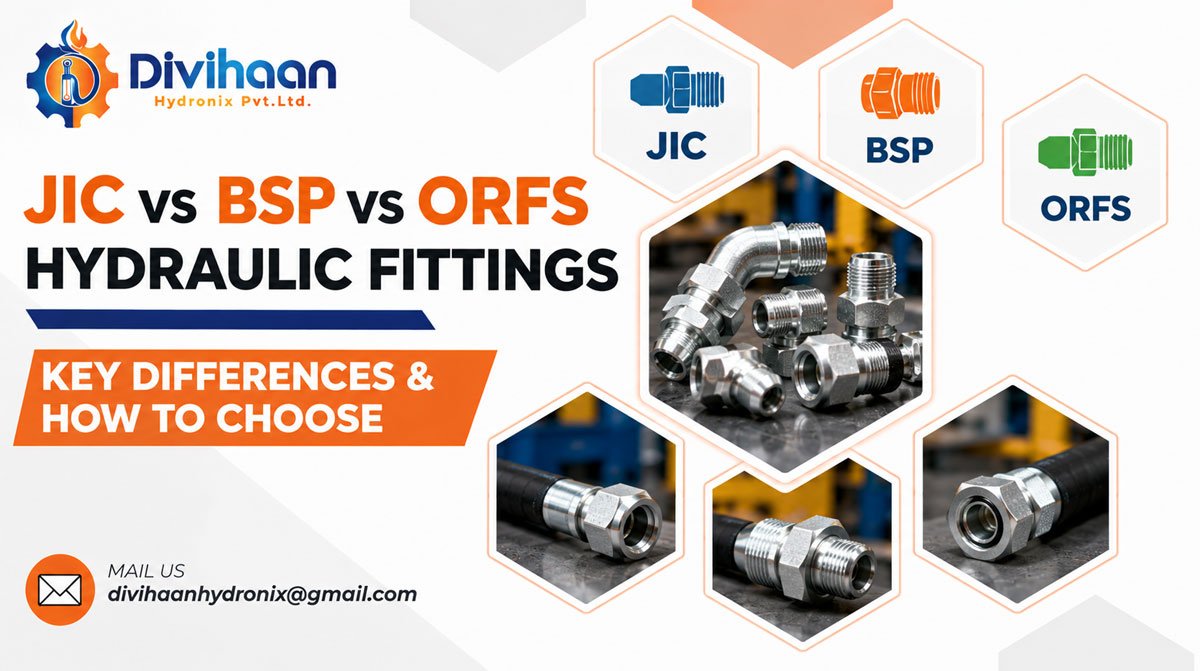
- BSP connections
- JIC 37-degree flare fittings
- ORFS (O-ring face seal) fittings
- Metric hydraulic fittings
- NPT tapered-thread connections
Using incompatible fittings can damage the connection or prevent proper sealing.
Recommended fix:
Identify the fitting type, thread dimensions, sealing method, and pressure requirements before installation.
Use verified compatible components and approved adapters where required.
Never force mismatched threads together.
5. Excessive Hydraulic System Pressure
Hydraulic hoses and fittings must operate within the rated limits of the complete assembly.
Pressure spikes, pressure pulsations, or incorrect system settings can place additional stress on connections.
Potential contributing factors include:
- Incorrect pressure relief valve settings
- Sudden valve closure
- Pressure surges
- Equipment overload
- Unsuitable hose assembly pressure ratings
Repeated exposure to excessive pressure may damage seals, fittings, or hose reinforcement.
Recommended fix:
Have a qualified technician check operating pressure and transient pressure conditions using suitable, rated diagnostic equipment.
Verify that the hose assembly and every connected component are suitable for the system’s maximum expected pressure.
Never increase pressure settings to compensate for poor hydraulic performance without determining the underlying cause.
5. Excessive Hydraulic System Pressure
Hydraulic hoses require suitable routing to accommodate movement, pressure changes, and equipment operation.
Poor routing can introduce excessive stress at the fittings.
Common installation mistakes include:
- Sharp bends near the hose end
- Insufficient hose length
- Twisting during installation
- Unsupported hose weight
- Contact with moving components
- Inadequate allowance for machine movement
These conditions may gradually weaken the hose or fitting connection.
Recommended fix:
Review the hose routing against the manufacturer’s installation requirements.
Maintain the specified minimum bend radius and avoid excessive bending directly behind the fitting.
Use appropriate supports, clamps, and routing arrangements without restricting necessary movement.
7. Excessive Vibration and Mechanical Stress
Industrial hydraulic equipment frequently operates under vibration, movement, and changing loads.
Repeated vibration can contribute to connection fatigue, hose movement, and mechanical damage.
Equipment such as hydraulic presses, construction machinery, and manufacturing systems may experience these conditions.
Recommended fix:
Inspect mounting points, hose supports, and routing.
Identify the source of abnormal vibration and correct it where possible.
Replace damaged assemblies and verify that the replacement arrangement accommodates expected machine movement.
8. Contamination and Damaged Sealing Surfaces
Dirt, metal particles, damaged threads, and debris can interfere with hydraulic fitting seals.
Even small contaminants trapped between precision sealing surfaces may prevent proper sealing.
Repeated assembly and disassembly can also damage fitting surfaces.
Recommended fix:
Use appropriate contamination-control procedures when servicing hydraulic connections.
Inspect sealing faces, threads, and O-ring grooves.
Replace damaged components rather than attempting to conceal defects using unsuitable sealants.
How to Identify the Source of a Hydraulic Hose Fitting Leak
Correct diagnosis is important because hydraulic oil may travel along the hose or fitting before becoming visible.
A wet fitting does not always mean that the fitting itself is defective.
The following table can help maintenance teams distinguish common symptoms.
| Observation | Possible cause | Recommended action |
| Oil around threaded connection | Damaged seal, incorrect assembly, incompatible connection | Inspect sealing design and components |
| Oil escaping from crimp area | Incorrect or damaged hose assembly | Remove assembly from service |
| Oil near hose bend | Hose fatigue, abrasion, excessive bending | Inspect routing and replace damaged hose |
| Leakage after maintenance | Incorrect reassembly, seal damage, contamination | Review assembly procedure |
| Repeated leakage during operation | Pressure spikes, vibration, movement | Investigate system conditions |
| Leakage around O-ring connection | Damaged or incompatible O-ring | Replace with specified seal |
These symptoms are diagnostic clues, not confirmation of a particular failure.
How to Fix a Hydraulic Hose Leaking at a Fitting Safely
A hydraulic hose leak repair should begin with identifying the failure, not immediately tightening the connection.
Step 1: Shut Down and Isolate the Hydraulic System
Stop the equipment according to its approved shutdown procedure.
Apply the required lockout/tagout measures and prevent unexpected machine movement.
Lower or mechanically secure suspended loads and isolate stored energy.
Step 2: Release Stored Hydraulic Pressure
Follow the equipment manufacturer’s pressure-relief procedure.
Hydraulic systems can retain pressure even after the pump has stopped.
Accumulators, cylinders, trapped fluid, and suspended loads may retain hazardous energy.
Never loosen a connection to determine whether pressure remains.
Step 3: Locate the Leak Without Direct Contact
Inspect the hydraulic system using an approved safe procedure.
Never use bare hands or fingers to locate a hydraulic oil leak.
High-pressure fluid injection injuries can occur through extremely small openings.
If injection injury is suspected, seek emergency medical treatment immediately, even if the wound appears minor.
Step 4: Inspect the Fitting and Hose Assembly
Once the equipment is safely isolated and depressurized, a qualified technician should inspect:
- Fitting threads and sealing faces
- O-rings and other seals
- Hose reinforcement and outer cover
- Crimp condition
- Hose routing and bend radius
- Component compatibility
Determine whether the problem involves a serviceable connection or a damaged hose assembly.
Step 5: Repair or Replace the Defective Component
The corrective action depends on the fault.
For a serviceable connection, the technician may need to replace a seal or correctly reassemble compatible fittings.
For damaged crimped connections, severely damaged fittings, or compromised hoses, replacement is generally the appropriate approach.
Do not apply makeshift patches, adhesives, or unapproved clamps to a high-pressure hydraulic hose.
Step 6: Verify the Repair
After reassembly, follow the manufacturer’s commissioning and testing procedure.
Ensure personnel remain clear of potential leakage paths and moving equipment.
Confirm that the connection remains leak-free under the specified test and operating conditions.
If leakage returns, stop the equipment and investigate the underlying cause rather than repeatedly tightening the fitting.
Hydraulic Hose Fitting Leak: Repair or Replacement?
Not every hydraulic fitting leak requires replacing the entire hose assembly.
However, some defects make replacement necessary.
| Condition | Typical corrective approach |
| Damaged replaceable O-ring | Replace with specified seal |
| Incorrectly assembled serviceable fitting | Inspect and reassemble correctly |
| Damaged fitting threads | Replace affected component |
| Leaking permanent crimp | Replace affected hose assembly |
| Cracked fitting | Replace fitting or assembly as applicable |
| Hose cover damage exposing reinforcement | Remove hose from service and assess replacement |
| Repeated leak with pressure surges | Correct pressure issue and replace damaged parts |
The final decision should follow the manufacturer’s instructions and a qualified inspection.
How to Prevent Hydraulic Hose Leaks at Fittings
Preventive maintenance can reduce the risk of recurring hydraulic oil leakage.
Select the Correct Hydraulic Hose and Fittings
Choose components based on operating pressure, temperature, hydraulic fluid compatibility, required hose diameter, and application conditions.
The pressure capability of the assembly is limited by its lowest-rated applicable component.
Follow Correct Installation Procedures
Use compatible fittings and manufacturer-approved assembly methods.
Avoid twisting, excessive bending, unsupported weight, and unnecessary mechanical loading at the connection.
Inspect Hydraulic Hose Assemblies Regularly
Include hoses and fittings in the equipment’s preventive maintenance schedule.
Check for visible damage, abnormal movement, oil residue, corrosion, and deterioration.
Inspection intervals should reflect operating severity, equipment criticality, and manufacturer guidance.
Maintain Hydraulic Fluid Cleanliness
Use appropriate filtration and contamination-control practices.
Keep open connections protected during maintenance and prevent dirt from entering the system.
Monitor Pressure and Temperature
Investigate unusual pressure fluctuations and operating temperatures.
These conditions may indicate problems elsewhere in the hydraulic system and can contribute to premature component failure.
Maintain Accurate Maintenance Records
Record recurring leak locations, replacement dates, component specifications, and corrective actions.
Maintenance history can help identify patterns related to incorrect assembly, unsuitable components, or demanding operating conditions.
Why Ignoring Hydraulic Hose Fitting Leaks Can Be Costly
A small hydraulic hose fitting leak may appear insignificant, but it can create wider maintenance problems.
Hydraulic Fluid Loss
Continuous leakage increases fluid consumption and maintenance requirements.
Equipment Downtime
Unexpected hydraulic failures can interrupt manufacturing, construction, and material-handling operations.
Contamination Risks
Fluid escaping from the system and contamination entering through compromised connections can create maintenance and reliability problems.
Reduced System Performance
Significant fluid loss may affect reservoir levels, available flow, and equipment operation.
However, a small external leak does not automatically mean that the hydraulic system has lost operating pressure.
Workplace Safety Hazards
Hydraulic oil leakage can create slippery surfaces, fire hazards in certain conditions, and high-pressure fluid injection risks.
Early identification and proper correction are essential.
Frequently Asked Questions About Hydraulic Hose Fitting Leaks
1. Why is my hydraulic hose leaking at the fitting?
A hydraulic hose may leak at its fitting because of a damaged seal, incorrect installation, incompatible connectors, damaged sealing surfaces, poor crimping, or excessive mechanical stress. The exact cause depends on the location and design of the connection.
2. Can a hydraulic hose fitting leak be repaired?
Some leaks at serviceable connections can be corrected by replacing specified seals or properly reassembling the fitting. However, damaged permanent crimps and compromised hose assemblies generally require replacement.
3. Can I tighten a hydraulic fitting to stop a leak?
Only when the connection is serviceable and incorrect assembly has been confirmed. The system must first be safely isolated and depressurized. Follow the fitting manufacturer’s assembly specification; overtightening can cause additional damage.
4. Why does a new hydraulic hose leak at the fitting?
A new hydraulic hose may leak because of incompatible fittings, incorrect crimping, damaged seals, improper installation, or unsuitable operating conditions. New components are not automatically free from assembly defects.
5. What causes hydraulic oil to leak from a crimped fitting?
Possible causes include incorrect crimp dimensions, incompatible hose and fitting components, improper insertion, or damage to the hose assembly. A leaking crimped assembly should be removed from service and assessed by a qualified specialist.
6. Can excessive hydraulic pressure cause fitting leaks?
Yes. Excessive pressure and repeated pressure surges can stress seals, fittings, and hose assemblies. The complete assembly must be rated for the applicable operating and transient pressure conditions.
7. How often should hydraulic hose fittings be inspected?
Inspection frequency depends on the equipment, operating environment, manufacturer recommendations, and risk assessment. High-duty equipment may require more frequent checks than equipment operating under relatively stable conditions.
8. What is the difference between a hydraulic hose leak and a fitting leak?
A hose leak originates from the hose body, while a fitting leak occurs at a connection, seal, or hose-end attachment. Both require safe isolation and proper diagnosis before repair.
Conclusion: Prevent Hydraulic Hose Fitting Leaks With Proper Maintenance
A hydraulic hose leaking at fitting connections should never be ignored.
Damaged seals, incorrect assembly, unsuitable fittings, poor crimping, excessive pressure, and improper hose routing are among the most important causes.
Identifying the actual failure point and following approved repair procedures can help reduce recurring leaks, equipment downtime, and workplace risks.
Routine inspection, correct component selection, and professional hose assembly practices are essential for maintaining reliable hydraulic systems.
Need Guidance on Hydraulic Hose and Fitting Selection?
Divihaan Hydronix provides a point of contact for businesses seeking information about hydraulic applications and component requirements.
Whether you are reviewing hose specifications, investigating recurring fitting leaks, or planning hydraulic maintenance, selecting compatible components is an important part of system reliability.
Visit www.divihaan.com to learn more about Divihaan Hydronix and discuss your hydraulic requirements.